
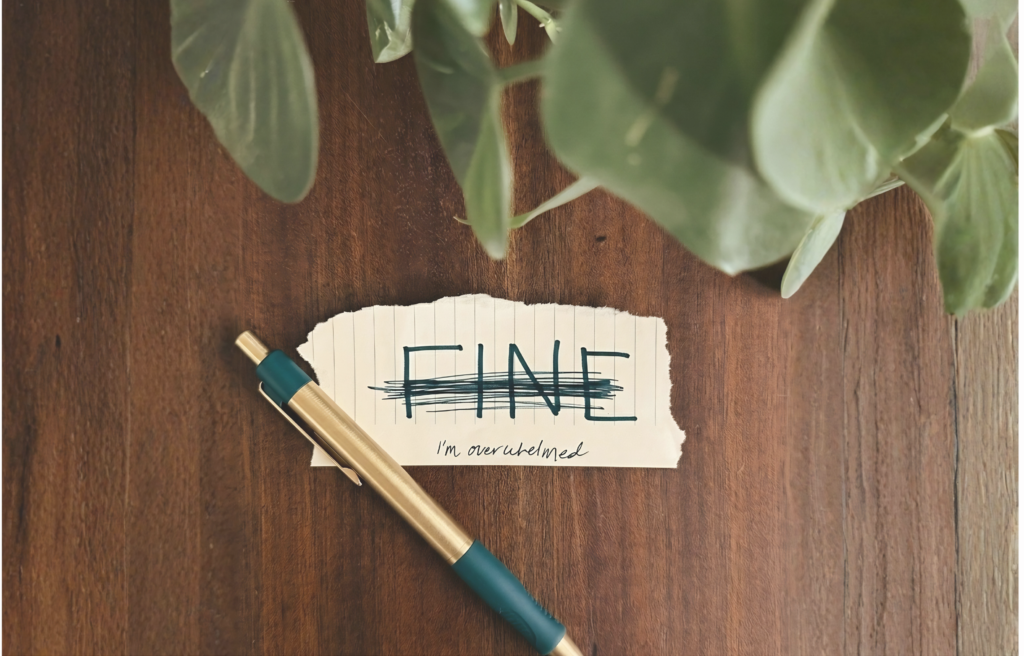
I’ve started a new kind of fast. It’s not about food, and it’s not about social media. I’m giving up a single, four-letter word that has become the default setting of my life, the grease on the wheels of my social interactions, and—lately—the greatest barrier to my own peace.
I’m giving up the word “fine.”
In the language of a ceasefire, “fine” is a white flag that doesn’t actually mean peace; it means surrender. It is the linguistic equivalent of a junk drawer—the place where we shove the feelings we don’t have time to sort, the truths that feel too heavy to carry in the checkout line, and the needs we’re afraid might “inconvenience” someone else if we let them breathe.
Most of us have been trained to be “useful.” We are the fixers, the managers, the anchors for our families, and the reliable engines of our careers. In those roles, “fine” is a survival mechanism. It’s a way to keep the gears turning without letting anyone see the friction.
But I’ve realized that when I use that word as a default, I’m performing a version of myself that doesn’t actually exist. I’m protecting other people from my reality at the expense of my own integrity.
Life isn’t a constant upward climb. We move through seasons of “Boom”—where our energy is high and our output is effortless—and seasons of “Bust,” where our capacity is thin and our souls are demanding a retreat.
When I’m in a “Bust” cycle, saying “I’m fine” is an act of self-betrayal. It’s a way of telling the world—and, more importantly, telling myself—that my current state isn’t worth acknowledging. It’s a way of saying: “My authenticity is less important than your comfort.”
I’m learning to replace the “Fine” shield with more honest masonry. Truth is the only soil where real peace can grow, but truth requires a more descriptive vocabulary. I’m testing out new ways to answer the standard “How are you?” that honor where I actually am:
• Instead of “I’m fine,” I’m trying: “I’m struggling a bit today, but I’m here.”
• Instead of “Everything’s fine,” I’m testing: “I’m feeling a bit overwhelmed, so I’m moving a little slower right now.”
• Instead of “It’s fine,” I’m practicing: “I actually don’t have the capacity for that right now, but thank you for asking.”
Dropping the shield is terrifying. It feels exposed. When you stop saying you’re “fine,” you risk someone asking a follow-up question. You risk being seen as someone who has needs.
But it’s also the only way to build a life where you are truly known. When we stop using “fine” as a default, we start allowing people to see the version of us that exists in the moment—not just the version we think we’re supposed to perform. We are clearing out the junk drawer of our souls to make room for a life that is actually ours.
When was the last time you said you were “fine” but meant something entirely different? If you dropped the shield today and were forced to use a more honest word, what would it be?
Let’s practice in the comments. No “fine” allowed.
